Down, down, profits are down

You may be interested to know that FinPro (the Local Government peak body representing the finance professionals) is currently surveying members regarding any initiatives their Councils have implemented to generate income from alternate revenue streams. FinPro are facilitating the survey following a request from Rural Councils Victoria (RCV).
Interesting if the survey is motivated by the current profitability of Victorian Councils that continues its downward spiral. The following graph is adapted from Victorian Auditor General’s Office data and shows profitability hit negative territory during the 2019-20 year and continued south for the 2020-21 year. For the technically minded, the graph is the adjusted underlying result across all 79 Victorian Councils. We won’t know the next 2021-22-year result until about November 2022 when all the Councils have completed their year-end financial reports.
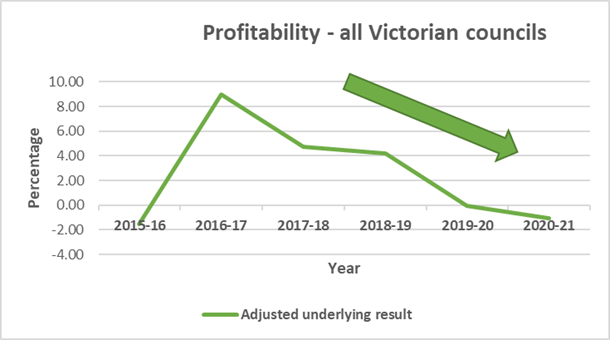
Rather than alternate revenue streams as the panacea for profitability, this writers view is that the elephant in the room continues to be shared services. The topic of Council sharing its resources has generated much rhetoric over prior years but not much in the way of action. While shared services may not add a lot of value to alternate (or additional) revenue streams, at least in the initial stages, sharing the limited resources does have the capacity to generate economies of scale and long-term savings.
The hesitancy to embrace shared services does require some rethink, or even a paradigm shift, regarding how Councils think about service delivery. Talking about paradigm shifts, pre Covid the view was that ‘working from home’ had its limitations and would probably not work as a viable longer-term solution. Now that we know that ‘working from home’ is the new norm, it’s interesting to note what can be achieved out of necessity – a pandemic led paradigm shift with a compelling reason for change.
Even with the current level of profitability (or lack thereof), there does not appear to be a compelling reason to change how services are delivered. However this view may begin to shift if financial results continue to head south that has the inevitable flow on ramifications to annual budgets with an increasing inability to adequately fund key services and capital works.
In the meantime, we will eventually see the results of the current focus on alternate revenue streams and how it will impact the bottom line of some Councils. This writer’s sense is that there should be some upside to alternate revenue streams. However, as Councils are generally not at a level of commercial maturity to embrace such initiatives, alternate revenue streams are unlikely to generate the significant impacts necessary to address the challenges now facing profitability within the sector.